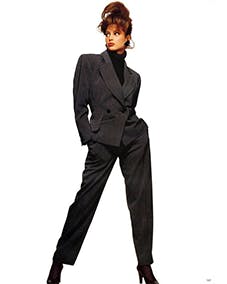
Today, an essential element of our wardrobe, the suit, consisting of a jacket and a skirt or trousers, can be worn on any occasion by choosing it in a matching or mismatched set and accessorizing it in different ways.
Context
It was after the mid-19th century that the suit as we know it appeared. Indeed, this period was marked by a strong evolution in women's fashion, due to the urbanization of cities, women started playing sports, such as tennis, and adopted the more practical jacket/skirt set for comfort. This new century freed women from the corset, allowing them to wear clothes with a straight cut.
In the 20th century, the suit became one of the central elements of the female wardrobe, and the very long skirt became shorter.
The New Look
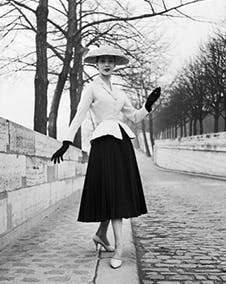
After the war and the difficult years that followed, women wanted to become more feminine than ever. The silhouette was glamorous and colourful. Christian Dior reached his peak with the New Look. The waist was emphasized and the corset favoured. The skirt was ample, long, and pleated. Colours returned and fabrics were rich.
The Chanel Suit
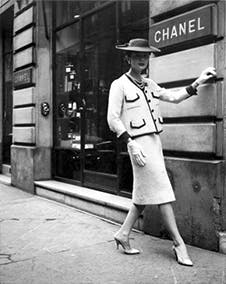
In the 1950s, Gabrielle Chanel delivered her interpretation of the women's suit, with tweed and a loose fit.
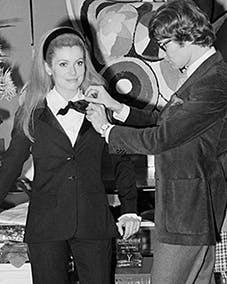
May 1968 was another liberating event for women and popularized trousers. Yves Saint Laurent, sensitive to the zeitgeist, developed a line of urban trouser suits for women in 1966 with an androgenous style that was adopted in the 70s by many celebrities like Catherine Deneuve.
The 80s were an eccentric, colourful era, where new materials and new styles appeared. Women became working girls and wanted to take the place of men at work while still being sexy. Women opted for wide trousers or close-fitting skirts. They chose to add volume to the shoulders and to cinch or belt their waists. Madonna inspired women, as did the television series Dynasty.
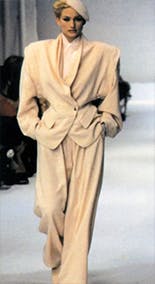
The suit of the 90s had a wide cut, like that of men. A completely relaxed attitude was adopted.